As a leader in e-commerce, Magalu recognized an opportunity to revolutionize its online customer experience. This project was a strategic pilot to integrate a new, AI-powered conversational assistant into its platform—the company's first-ever attempt to use a chatbot for direct sales and product recommendations.
Our initial focus was the complex smartphone category, with the clear objective of proving the concept and scaling the solution to the entire product catalog in the future
As the lead UX designer, I was responsible for crafting the entire user experience, from defining the chatbot's persona and conversational flows to ensuring it effectively understood user needs and provided confident, helpful recommendations.

Magalu's beloved brand avatar, Lu.
Client
Magazine Luiza, more commonly known as Magalu, is one of Brazil's largest and most influential retail companies. It's a major player in both physical stores and e-commerce, and it has become famous for its aggressive digital transformation strategy and its highly popular virtual brand ambassador, Lu.
Solving Decision Paralysis: Our Generative AI Approach
Challenge
Prior to this project in 2023, Magalu's e-commerce platform lacked a dynamic, conversational tool to guide customers through the product discovery process across its vast and diverse catalog. The traditional user experience, limited to filters and search bars, could not effectively understand a user's unique needs, preferences, or budget in a natural, conversational manner. This often led to decision paralysis and friction for customers exploring a wide range of products, from electronics to home goods.
The core challenge was to design and implement a new, AI-powered system that could serve as a knowledgeable and empathetic shopping advisor for the entire platform, capable of transforming a complex search into a simple and personalized conversation.
This pioneering project was a strategic initiative to create the foundational technology for an AI assistant that could scale to serve all of Magalu's product categories.
Solution
To address this challenge, we embarked on a strategic project to design and implement a new conversational AI solution powered by the latest generative AI technology. A key component of our approach was to integrate Magalu's beloved brand avatar, Lu, as the face of this new tool. This was a deliberate choice to humanize the experience, build trust with customers, and create a strong brand connection.
As the lead UX designer, my role was to create a human-centered experience that would move beyond scripted responses and rigid search filters. The solution was an intelligent conversational assistant capable of understanding natural language, asking clarifying questions, and providing personalized product recommendations based on the user's expressed needs and desires.
This pilot was designed to not only serve as a proof of concept but also to build the foundational framework—including a scalable conversational architecture and a trained model—that would allow Magalu to confidently expand this service to its entire product catalog in the future.
Building a Foundation: Roles, Tools, and Timeline
Team
The core design group included a UX designer, a UI designer, and a dedicated UX writer, all focused on creating a cohesive and human-centered conversational experience.
I worked closely with two Developers and an IT Manager, acting as the primary mediator between the design and technical teams. This crucial role ensured a constant, clear dialogue, bridging the gap between design principles and technical feasibility to maintain a smooth and efficient implementation process.
Our work was guided by both a Design Manager and our key stakeholder, allowing for rapid feedback and strategic alignment throughout the project.
My Role
Lead UX designer, I managed and guided a cross-functional team of eight.
Timeline
Overwall: 4 weeks. Discovery & Research: 1 week. Design & Iterations: 3 weeks.
Process
•User Stories•User Flows•Wireframes•Style Guide•Prototype•Development
Tools
•Figma•FigJam•Dialogflow•Vertex AI
Balancing UX and Technical Requirements: Our Iterative Process
Methodology
1. Research 2. Ideation 3. Design 4. Handoff
1. RESEARCH
Kickoff
As the lead UX designer, I initiated this project with a comprehensive kickoff meeting to align the team on the client's vision for a new conversational AI solution. Our core objective was to build a pilot that would not only prove the value of conversational commerce but also serve as a scalable foundation for future expansion across Magalu's entire catalog.
Requirements
The client's requirements were clear and multi-faceted. They sought a virtual assistant that seamlessly integrated their brand voice, embodied by the avatar Lu, to create a personal and trustworthy connection with customers. A secure environment for their product catalog was paramount, as was ensuring high speed and performance. A critical requirement across all projects was the integration of Google's Dialogflow and Vertex AI, driven by existing partnerships and our IT team’s specialized expertise.
My role was to bridge the gap between design and technology. While leading the UX process, I rapidly acquired technical knowledge of these platforms to effectively translate design principles into technical requirements. My background in web design and development was instrumental in fostering clear communication between the design and IT teams, ensuring a smooth and efficient implementation of the user experience.
2. IDEATION
User Stories and User Flows
My first step was to translate our strategic goals and client requirements into a tangible plan. I began by meticulously crafting user stories to define the core functionalities of the new AI assistant, identifying critical opportunities for conversational design to improve the user journey.
Using Figma, I created a comprehensive document that not only captured these user stories but also outlined the initial user flows. This became our single source of truth, facilitating seamless collaboration across teams. As the lead designer, I conducted group sessions with my design peers, content specialists, and the IT development team to collaboratively iterate on these flows. Our goal was to ensure that every user story was addressed with maximum efficiency and a human-centered approach, all while integrating the brand's voice and leveraging Lu's persona to build trust.
The final user flows effectively balanced a smooth user experience with the technical requirements of Generative AI. They clearly mapped out key moments of interaction, specifying the desired outputs and how the system should handle various user intents.
For example, a user asking for a specific product recommendation would trigger a multi-turn conversation where the AI would ask clarifying questions about their needs before providing a tailored response. This meticulous planning ensured that we were building a system that was not just functional but genuinely intuitive and helpful.
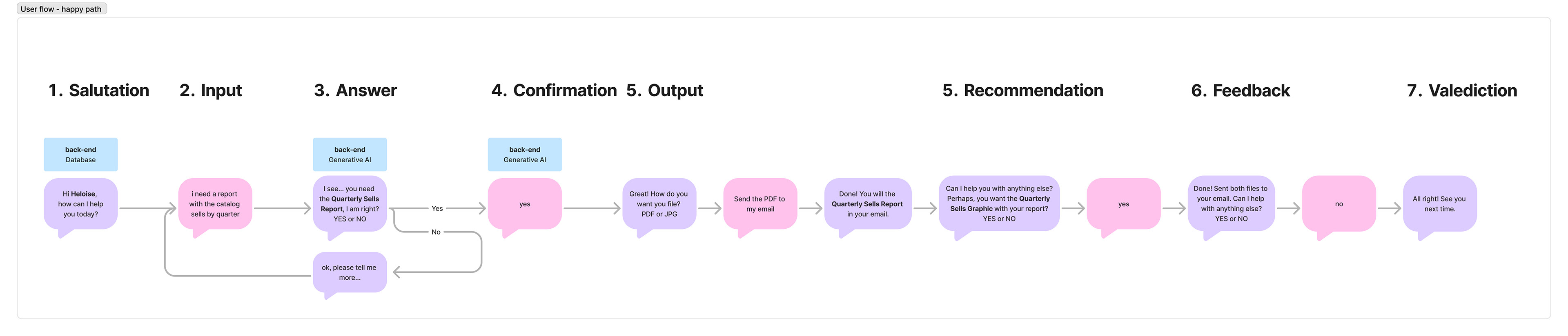
User flow: happy path
3. DESIGN
Wireframes
My role wasn't just about the words the AI would say; it was about the entire user experience. Despite this being a backend-heavy project, I saw a critical opportunity to improve the front-end interface. I developed strategic wireframes that optimized user interaction with the new AI. My recommendations focused on subtle but significant changes, such as refining the button positioning and updating the iconography to prevent conflicts with the existing app design and ensure intuitive navigation. This work was crucial to seamlessly integrate the Generative AI and its new functionalities while staying within the constraints of Google's Dialogflow and Vertex AI.
UI Refresh
To create a more cohesive and engaging brand experience, we conducted a targeted UI refresh. We introduced a new set of icons and refined typography, but the most impactful change was the integration of Magalu's brand avatar, Lu, as the face of the virtual assistant. This small but powerful addition injected greater brand personality and helped build a stronger, more personal connection with users.
Prototypes
Before moving to the technical implementation, I created interactive prototypes of our user flows. These prototypes brought our designs to life and served as a crucial tool for team collaboration. By using Figma's real-time features, we were able to run through all relevant scenarios and potential variations in a dynamic environment. This allowed us to efficiently finalize design decisions, streamline the development process, and save valuable time before implementation in Dialogflow.
4. HANDOFF
Design Handoff
Handoffs were conducted in two distinct phases to ensure a smooth transition from design to development. First, for the front-end enhancements, we delivered a comprehensive style guide that complemented their existing Design System. This guide included the new UI elements, typography, and iconography, as well as a detailed chapter on the virtual assistant's identity. Featuring Lu's avatar with various expressions tailored for different scenarios, this approach was vital for building a brand-aligned, human-centered experience that fostered a sense of connection rather than a mechanical interaction.
Technical Handoff
For the back-end development, I personally translated the refined user flows into clear, technical maps. This documentation was specifically crafted to accommodate the AI's requirements within Google's Dialogflow and Vertex AI platforms. This approach was crucial for efficient development and streamlined issue resolution, enabling rapid adaptation to client requests and error corrections.
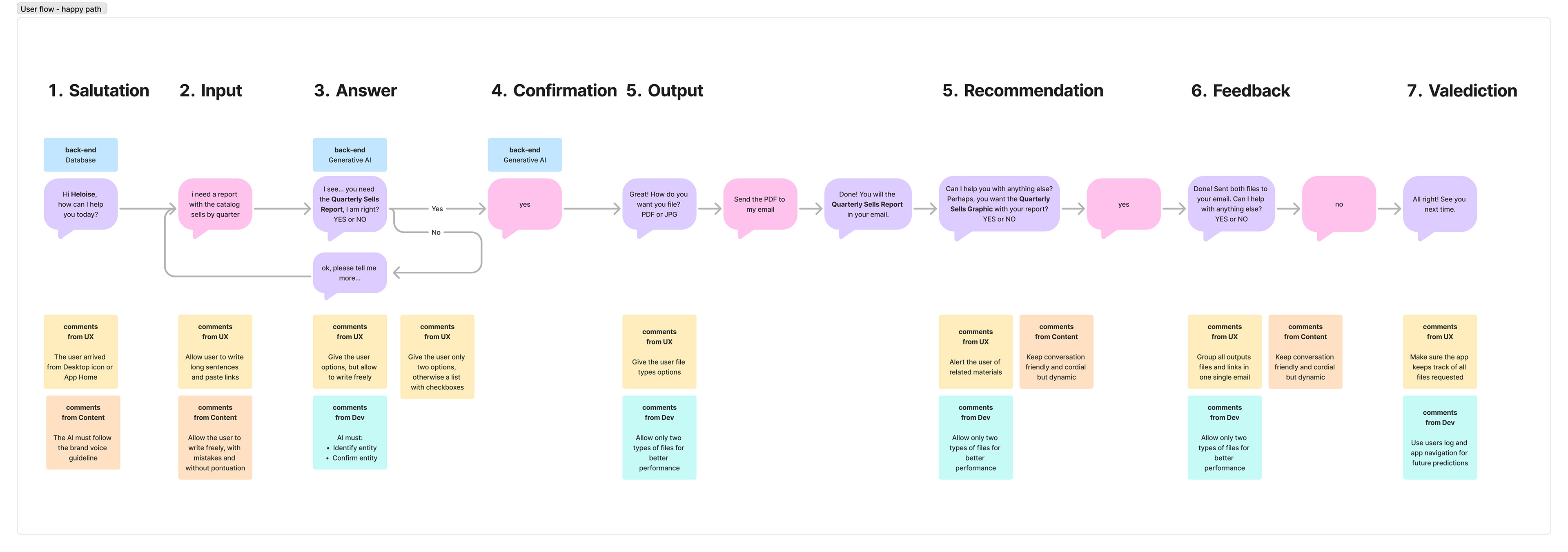
User flow: happy path - with instructions for all teams
The Outcome: A Foundation for Magalu's AI-Powered Future
Reflection
This project successfully established a new paradigm for customer engagement at Magalu through a strategic Proof of Concept executed in just four weeks. By leveraging the latest Generative AI and integrating the beloved brand avatar, Lu, we created a human-centered conversational experience that solved a critical business problem. The strategic integration of Google's Dialogflow and Vertex AI, coupled with a structured process and a focus on both UX and technical requirements, resulted in a scalable solution that set a strong foundation for the future of conversational commerce.
Leading a distributed team on such a compressed timeline revealed the critical necessity of fostering cohesion and focus. With everyone finding time in their already busy schedules, the close proximity to the main stakeholder was also crucial, enabling us to make quick decisions and receive rapid feedback. This experience underscored the importance of clear communication, adaptability, and a deep understanding of both user and technical considerations in crafting truly impactful, AI-driven experiences. Ultimately, our open dialogue enabled us to synthesize diverse viewpoints into a cohesive and comprehensive final product.